
The air conditioning has arrived: the checks to do before the first hole
Published on 22 November 2026
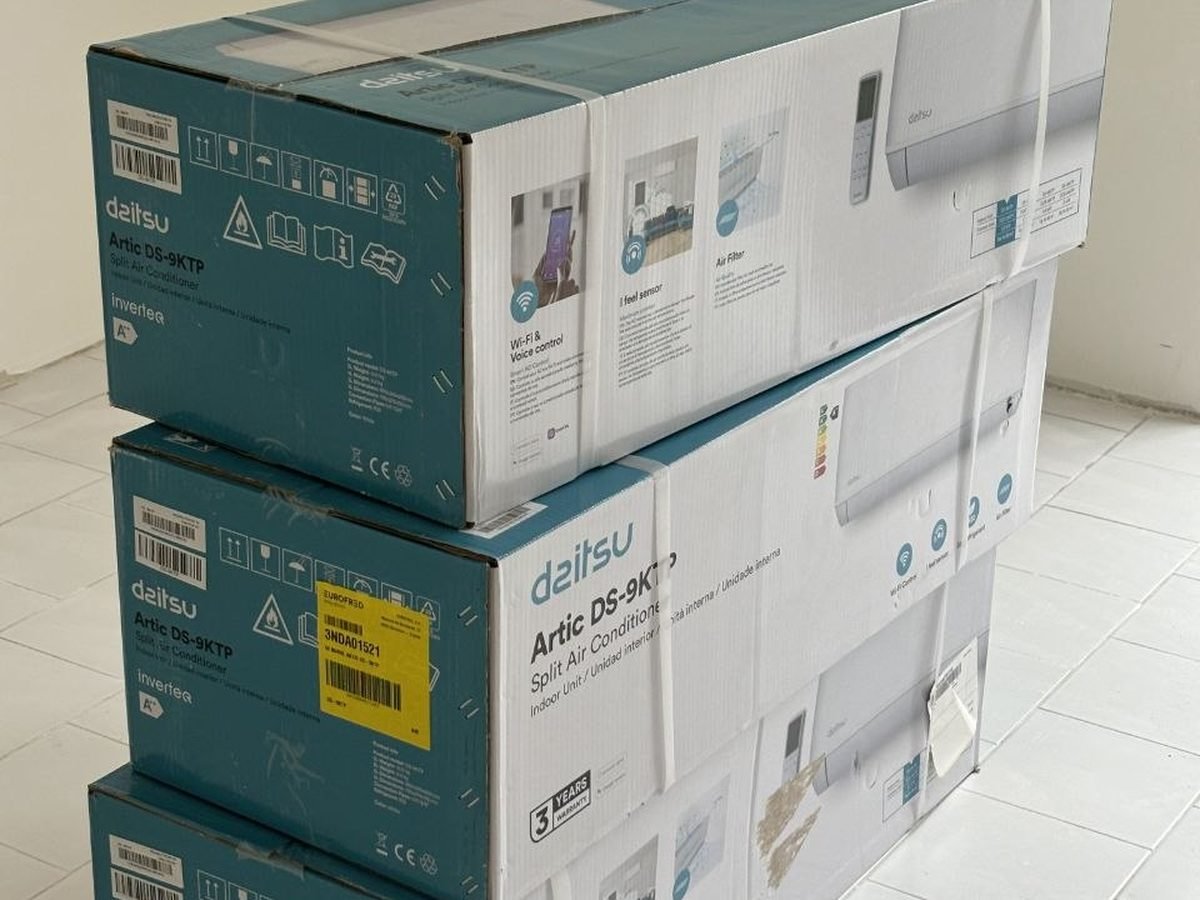
Delivery day feels like progress: the boxes are in the hallway, the installer has a date, and the renovation is finally getting its air conditioning. It is also the last moment when a mistake costs nothing. Once the first hole is drilled, a wrong capacity unit or a badly planned position becomes a change order. Between the courier leaving and the technician opening his drill bag there is a short window — usually an hour or two — in which everything below can still be checked, questioned and corrected for free.
Check what actually arrived, not what you picture in your head
The label on each box tells you the model, the nominal capacity, the energy class and the pairing between indoor and outdoor units. Read it against your quotation before anything is unpacked. The three most common mismatches are easy to name and, if found after installation, expensive to undo.
First, capacity per room. A unit sized for a living room will be overkill — and noisier than expected — in a bedroom; a unit sized for one bedroom will run continuously in an open-plan space and never reach the temperature you were promised. The figure on the label (kilowatts or BTU) should match the calculation that justified the price you agreed, room by room, not a single number for the whole flat.
Second, the split logic. If the proposal was a multisplit — one outdoor machine feeding two or three indoor heads — confirm that every head and the correct outdoor unit are on the delivery note. A three-head system delivered with a two-head outdoor section is not a small discrepancy; it is a different system.
Third, the seasonal efficiency label. Power figures get all the attention, but the SEER and SCOP classes are what will shape your electricity bills for the next ten summers. If the delivered class is lower than the one quoted, stop and ask before unboxing.
Photograph the labels before anything is opened
Sealed boxes carry serial numbers, model codes and the transport document. A few photos on your phone, taken before the tape is cut, serve two purposes. They support a warranty claim if the unit fails inside the first year, and they settle disputes about what was delivered versus what was ordered — a conversation that is entirely different when it happens over images instead of memory. If a box arrives badly dented, with a crushed corner or a puncture, photograph that too, note it on the delivery document before signing, and do not let the installation proceed on that unit until the supplier confirms it. A flattened pipe inside a condenser is not visible from the outside, and it is not your problem to discover next August.
Agree the positions on site, in chalk, before the drill comes out
Placement is the part of an air-conditioning job that is decided in minutes and lived with for years. The indoor unit needs a wall with clear airflow in front of it, enough headroom for the filters to be removed during maintenance, and a route for condensate drainage that falls, even slightly, in the direction of a drain or a lawful outside drop. It should not blow directly on to the head of the bed or the sofa where the family actually sits.
The outdoor unit needs ventilation on all sides where the manufacturer asks for it, a solid support, drainage of its own, and a position whose noise does not point straight at a neighbour’s bedroom window. Ask the installer to mark the final positions in chalk or tape on the wall, and walk the rooms to look at them before you approve the drilling. A position that reads well on a sketch can be a surprise when you see the unit above the dining table.
Ask, in the same breath, how far the two units will be apart. Refrigerant pipe runs have a maximum length and a standard allowance included in the quote; beyond it, every extra metre is money, and long runs also cost efficiency. If the route between indoor and outdoor crosses structural elements, that is decided now — not while someone is already on the scaffold.
The boring part that makes everything else work: power and passage
Confirm there is a dedicated circuit for the outdoor unit, in the panel, correctly protected, and that the cable section matches what the manual demands. Ask who supplies and installs that circuit if the quotation assumed it existed and it does not. Then look at the wall passage between the units: what kind of wall it crosses, who core-drills it, where the sleeve will sit and who makes good around it. These small boundary questions — who does the drilling, who does the patch, who runs the cable — are the origin of most arguments on installation day, and they cost nothing to settle before it.
What a sealed box still cannot tell you
Checking the delivery well does not commission the system. The commissioning is what happens at the end of the installation: a real test cycle at both heating and cooling, a look at the condensate actually leaving, a note of the pressures where the installer uses a gauge, and a demonstration you receive with your own eyes, not a signature. Ask for the paperwork that comes with the unit — invoice, warranty registration and, if the installer holds it, the certificate the refrigerant work requires in Portugal. Keep the boxes for a couple of weeks after installation, not just until it starts: if a unit has to go back, you will be glad they are in the garage.
None of these checks need a technical background; they need thirty quiet minutes before the work starts, a printed copy of the quotation and a phone camera. Whether you use our crews or another contractor, this hour belongs to you — and it is, by a wide margin, the cheapest hour in the whole project.