A newly finished wall can make it harder to answer a question about the work behind it. Once a service route is covered or an opening is closed, a missing photograph, an unresolved position or an unanswered technical question can become more difficult to investigate. The useful moment to organise those questions is before the next layer hides the relevant area, not during the final walk-through.
For an owner following an Algarve renovation from elsewhere, an intermediate review can provide a clear point for discussion. It is not a substitute for the checks required from the responsible professionals. Its purpose is to identify what needs an answer, what evidence is available and whether the next activity depends on a decision that is still outstanding.
Define the area and the next covering activity
Start with a location rather than a broad statement that a room is ready. Identify the wall, ceiling zone, floor area or service opening under discussion. Then ask what the next activity will cover and which information would become harder to obtain afterwards. A review limited to one defined area is easier to understand than an instruction to check everything.
The appropriate questions depend on the design and the work. A photograph of a service route may help someone locate it later, but it cannot establish that an installation meets its technical requirements. Ask the relevant designer, technical lead or contractor which checks and records apply. Keep their answer separate from an owner choice about appearance or layout.
Separate a visible observation from a technical conclusion
A photograph can show an opening, a route or a stage of surface preparation. It cannot, by itself, prove pressure-test results, electrical safety or the performance of material concealed behind a finished face. A useful review note says what is visible and identifies the document or qualified person needed to answer the separate technical question.
Avoid turning a general progress update into an approval. If a position appears different from the agreed drawing, record the location and ask for clarification. Do not describe it as an accepted change simply because it appears in a recent image. If a required test record is missing, say that the record has not been supplied; that is different from asserting that a test failed or never happened.
Keep photographs attached to the right location
A useful image record identifies the room and the part of the room. A wider view can establish orientation, followed by a closer view of the relevant detail. Where possible, preserve enough fixed features to make the location understandable later. A cropped detail without context may be difficult to place once finishes have changed the appearance of the space.
Keep the original file alongside the note that explains what question it supports. If the evidence includes a drawing, record the version being discussed. Photographs taken at different stages should remain separate unless their relationship is clear. Similar tiles, paint or fittings do not prove that two images show the same location or form a confirmed before-and-after pair.
Give unresolved questions an owner and a next action
Before a review call, group the open points by location. Each point needs a clear question, the person expected to respond and the activity affected by the answer. Some issues require an owner decision, such as confirming a visible fitting position. Others require information or a technical judgement from the relevant professional.
A useful response records what was decided and which current document or instruction reflects it. If the answer remains incomplete, keep the point open. A meeting date or a message marked as read does not resolve a dependency. Where the next step would hide the area, ask the responsible party to explain the proposed sequence while the question is outstanding.
Check what the response actually closes
An answer may close one issue without resolving every question about the area. Confirmation of a location is not confirmation of an installation test. Receipt of a photograph is not acceptance of workmanship. Keep these distinctions visible so that a short update does not acquire a broader meaning when it is forwarded to another participant.
The same approach helps at the final review: it provides a record of which questions were answered earlier and which remain open. It does not create a contractual acceptance or replace any applicable professional responsibility. For project-specific coordination, you can discuss the scope and relevant contacts with Build It Now rather than assuming a general checklist describes the arrangements on your own project.
Use the image as context, not proof
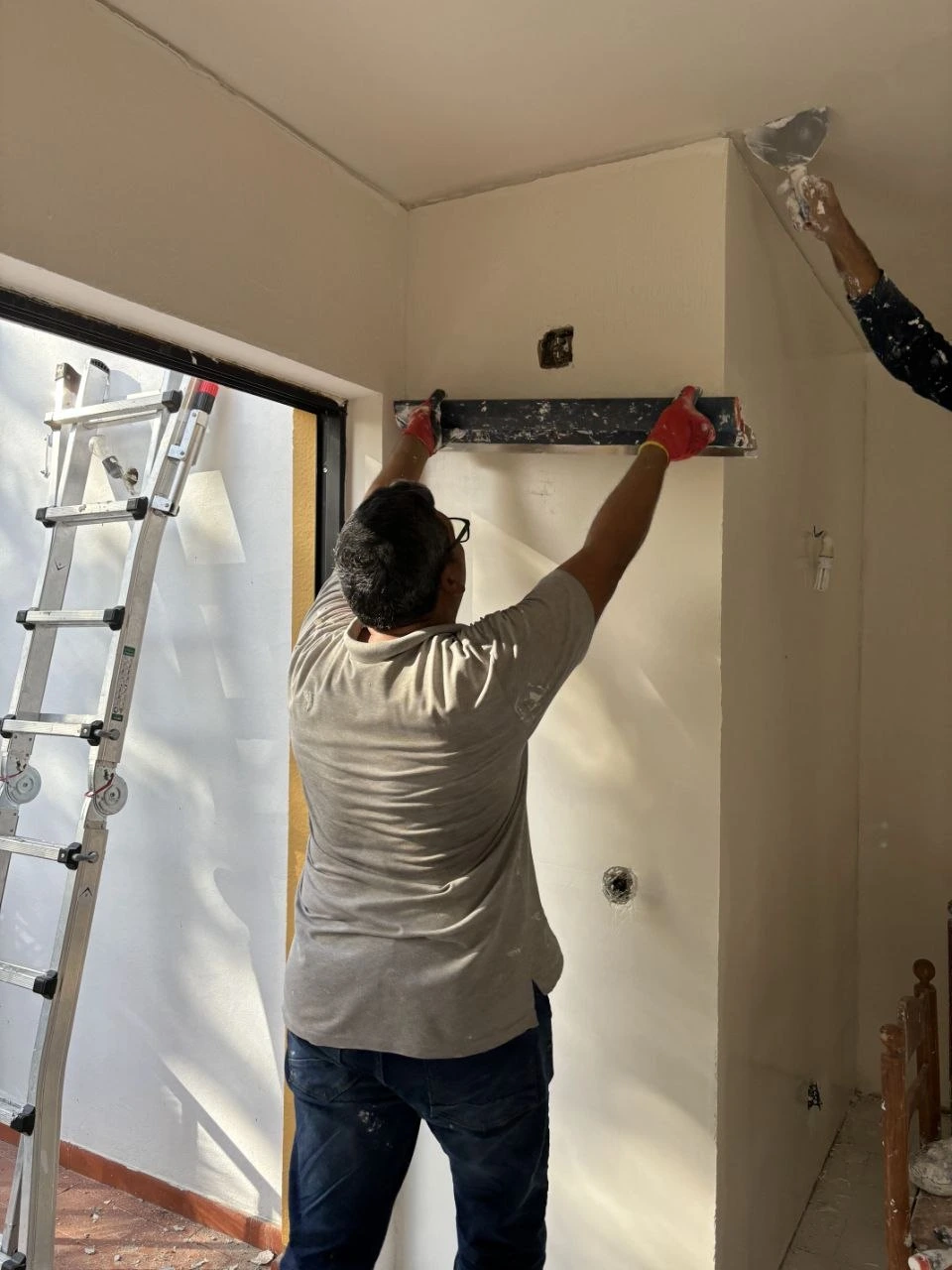
The accompanying Alfagar photograph shows wall-surface preparation in progress. It illustrates a stage of renovation where different questions may still need clarification; it does not document a hidden-services inspection or certify the condition of an installation. The practical value of an intermediate review comes from the specific question and supporting evidence, not from the appearance of a busy worksite.